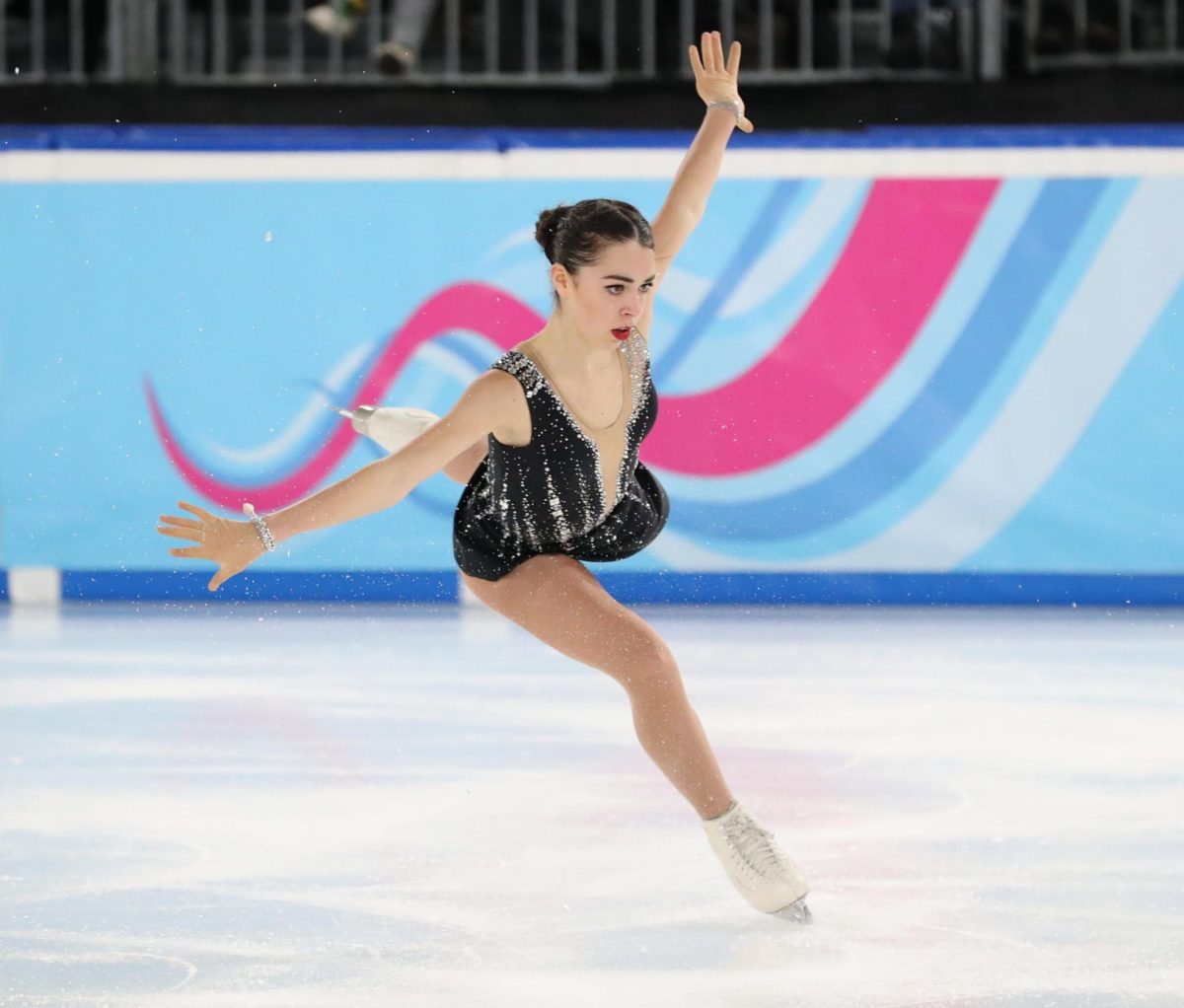
On the ice, figure skaters do not just compete against each other and themselves. They have a much greater enemy: gravity.
Modern Olympic figure skating is defined by high difficulty jumps that push skaters toward the edge of human capability. In the 2026 Olympics, everyone was talking about quads, jumps involving four rotations, and about Ilia Malinin, the American skater nicknamed the “Quad God.” The buzz around Malinin was not just that he could do a quad, but that he landed a specific type of quad: the quad Axel. Figure skating has six distinct jumps and each can be performed with four rotations. Malinin’s achievement marked the final of those six to reach the quad milestone.
Once performed as single rotations in early competitive skating, jumps evolved into doubles by the mid-20th century as training and technology improved. By the 1970s and 1980s, triple jumps became standard at the elite level, but quadruple rotations were still widely viewed as impossible. The thing is: a quad requires more rotations than a triple, but a skater is in the air for roughly the same time. So the trick is to spin faster. “It’s a race against gravity,” says Kurt Browning, the American figure skater who kicked off the “quad revolution” when he landed the first quad jump in competition.
Jumps in figure skating are defined by how skaters take off from and land on the ice. The Axel, Salchow, and Loop are edge jumps, which use only the blade’s edge for lift. The Toe Loop, Flip, and Lutz are toe-pick jumps, which use the toe pick, the small serrated tip at the front of the blade, to generate lift. All jumps are entered backward, with the exception of the Axel.
The Toe Loop begins on the outside edge of the takeoff foot, with the free foot’s toe pressing into the ice to help vault the skater into the air. After rotating, the skater lands on the outside edge of the starting foot. In 1988, Browning landed the first quadruple Toe Loop, the first successful quad of any kind in competition. He proved that four rotations were physically possible, changing the sport forever.
The Salchow is an edge jump that takes off from the inside edge of one foot and lands on the outside edge of the opposite foot. Unlike toe jumps, it relies entirely on the skate’s edge for lift and rotation. In 1998, American skater Timothy Goebel landed the first quad Salchow, proving that quads could be achieved without toe-pick assistance.
The Lutz is a toe-assisted jump that starts the same way as the Toe Loop, but instead of landing on the same foot, the skater lands on the outside edge of the opposite foot. Despite its higher difficulty, the Lutz achieved its first quadruple landing before either the Loop or the Flip, executed by American skater Brandon Mraz in 2011.
The Loop takes off from an outside edge and lands on the outside edge of the same foot. More difficult than the Salchow, the Loop requires the skater to land on the same foot, making control harder. The first quad Loop was landed in 2016 by Japanese skater Yuzuru Hanyu, five years after the quad Lutz.
The Flip is another toe-assisted jump that differs from the Lutz in only one way. Instead of the outside edge of the foot, the skater uses the inside edge. With both, you use the opposite foot toe-pick and land on the outside edge of that same foot. The first quad Flip was landed in the same year as the Loop, in 2016 by Japanese skater Shoma Uno.
The Axel is unique among figure skating jumps as the only forward-facing jump, launching from the outside edge of the takeoff foot and landing backward on the outside edge of the opposite foot. Because the jump begins facing forward, a single Axel requires one-and-a-half rotations, making it inherently more difficult than any other jump. Similarly, a quad requires four-and-a-half rotations. In 2022, “Quad God” Malinin became the first person to land a quadruple Axel, achieving a feat that had long been considered nearly impossible in figure skating. He remains the only person in the world who can carry out this jump.
Now that skaters have conquered quads, the next logical step would be five rotations. But is a quintuple jump even possible? Many don’t think it is. Still, there was a time when quadruple jumps seemed impossible too.
Olympic medalist Shoma Uno says “the quadruple jump was previously considered an unrealistic thing for human beings. But now, the fact that so many skaters hit it almost naturally means that somebody will land a quintuple someday.”