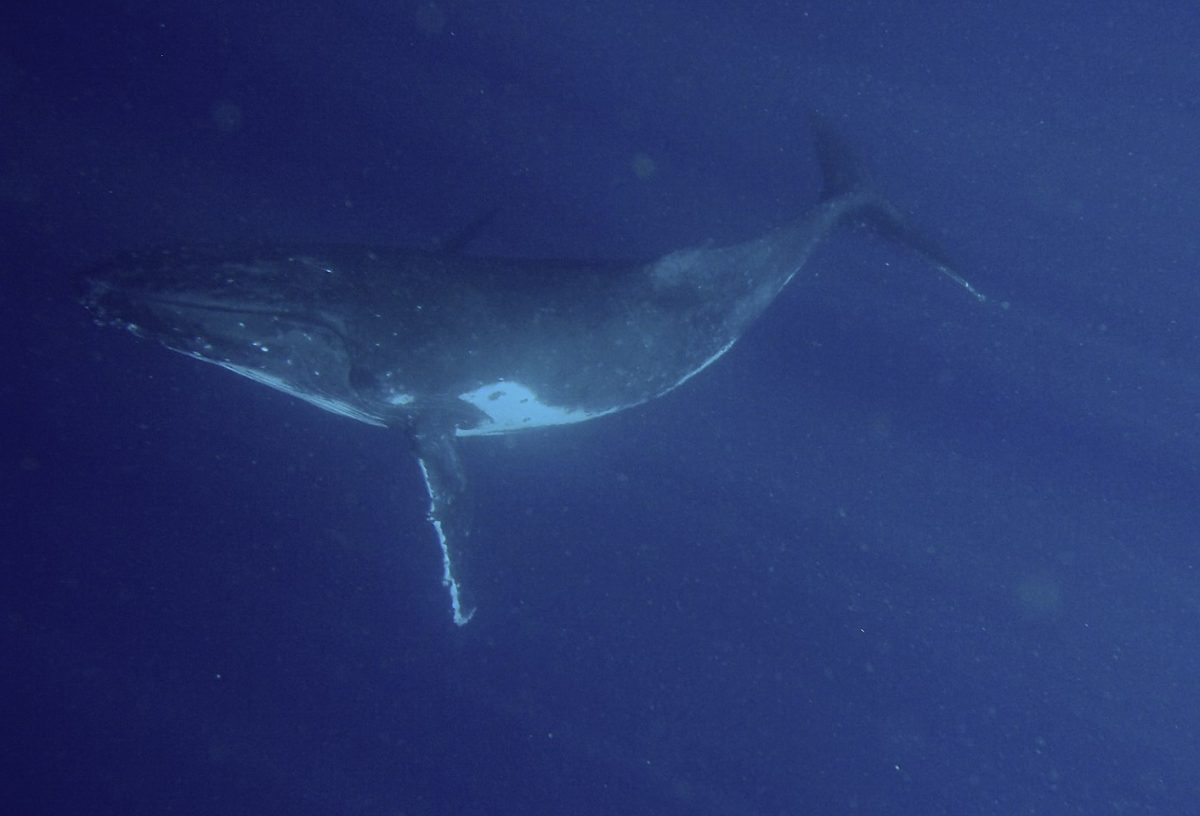
The key to improving cancer treatment could lie in whales, according to a research study led by Northern Arizona University assistant professor Marc Tollis. Published in 2019, the researchers’ discoveries showed that whales have genetic adaptations that allow for surprisingly low rates of cancer despite them being such large animals.
Cancer is the uncontrolled growth of abnormal cells that are caused by DNA mutations. These mutations often occur when cells divide incorrectly and if left unchecked will spread through the rest of the body. Whales have hundreds of times the amount of cells compared to humans, meaning that, in theory, they have a much higher chance of cell mutation. However, the research conducted by Tollis and his team proved the opposite: whales actually have much lower rates of cancer than humans. This phenomenon, called Peto’s Paradox, was first discovered in the 1970s and has been the subject of many studies since then, with dozens of papers published in recent years. Scientists have also studied mammals such as elephants who share similar cancer prevention strategies to whales.
Tollis’s team decided to investigate the reason behind why whales have better cancer prevention strategies. This question took them to the coast of Massachusetts where they obtained a skin sample from a female humpback whale named Salt. Other researchers have been recording data on Salt since the 1970s, so there is no shortage of information on her. Tollis’s team used the skin sample to build a map of the humpback whale’s DNA and compared that information to the genetic profiles of other mammals.
The researchers compared Salt’s DNA to that of other cetaceans such as the blue whale, bowhead whale, and sperm whale to find out their shared techniques for preventing and fighting cancer. They then compared the humpback genome to humans, who do not have the same cancer defenses.
The researchers concluded from their studies that, as whales evolved to become larger animals, their genes involved in preventing cancer improved due to natural selection. For example, the results showed that whales have extra copies of genes that control apoptosis, the body’s process of getting rid of damaged cells. In addition, other parts of the whale genome that regulate cell division, DNA repair, and tumor suppression evolved faster in whales than in humans. In other words, Tollis explains that “these important ‘housekeeping’ genes, that are evolutionarily conserved and normally prevent cancer, had to keep up in order to maintain the species’ fitness.”
Researchers believe that by understanding the anticancer strategies of other species like whales, they can come up with more effective cancer prevention and treatment for humans. Tollis adds that “Our goal is not only to get nature to inform us about better cancer therapies, but to give the public a new perspective of cancer.” He also hopes that the discovery that whales could be beneficial to human healthcare will motivate the appreciation of biodiversity, arguing that “we need all the reasons for conservation that we can get.”