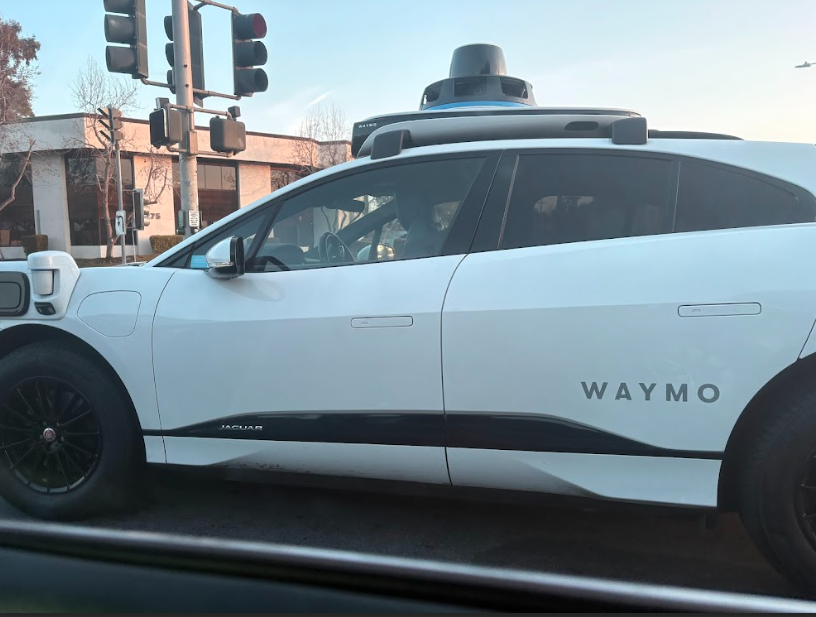
As kids, many people have imagined a future with out-of-this-world technology, including robots, and vehicles that didn’t need anyone to drive to get around. However, what once seemed like something from a sci-fi book has now become reality. On the streets of cities like San Francisco, Phoenix, LA, and Miami, companies like Waymo are turning that childhood fantasy into a real transportation system with their self-driving vehicles. The cars have many technological advancements, including being powered by artificial intelligence, radar, laser sensors, and cameras. As the company continues to rise to popularity, one question remains: is this the smarter and safer future of transportation or are there still challenges that need to be addressed?
Waymo is a subsidiary of Alphabet Inc, which is also the parent company of Google. The project started in 2009 and has grown into one of the most recognized autonomous vehicle companies. Since the company’s launch, Waymo has moved past their testing stage and now operates driverless ride-hailing services through its mobile app. The company’s technology uses lidar sensors, radar, high resolution cameras, and a detailed 3D mapping system that allows the car to detect pedestrians crossing and changing road conditions in real time. The shift from prototypes to actual autonomous public transportation is a major turning point in technology, especially artificial intelligence.
Waymo has seen rapid growth, largely because of impactful improvements and financial help from its parent company, Alphabet. Waymo had undergone many technological changes, using machine learning to improve how the vehicles responded to different situations. The company has expanded the number of electric vehicles, involving partnerships with car companies like Jaguar to add the new self- driving technology to existing car models. Waymo has heavily invested in data collection and testing and has logged millions of autonomous miles on public roads to help them refine their system. This combination of AI development and financial support has allowed Waymo to scale faster than its competitors. According to cnbc.com, the co-CEO of Waymo stated that “Waymo is the only company that’s operating fully driverless cars at scale…recently notching 10 million rides.”
With Waymo, people have argued that there are numerous advantages, including improved road safety. According to Waymo’s website, Eva from San Francisco states that “Waymo provides convenience, prioritizes safety, and is committed to sustainability.” Furthermore, on the same website, Maya from San Francisco states that “[Her] rides with Waymo are constantly safe. It is almost as if I hail the exact same vehicle each time.” Many of the numerous users of Waymo have agreed that the vehicles are especially helpful to elderly and those with special needs, as it makes it a lot easier for them to get around.
On the other hand, there are specific public concerns about the vehicles. According to houstonchronicle.com, local residents have complained about Waymo’s lingering in neighborhoods and blocking driveways and intersections, causing complaints. Additionally, in several cities, Waymo vehicles have been involved in problematic behavior on the road, including making illegal turns and stopping suddenly at intersections, according to Northeastern Global News. While opinions about Waymo clearly seem mixed, its expansion shows that the future of transportation is rapidly changing, and the question is whether or not we are ready to ride along.