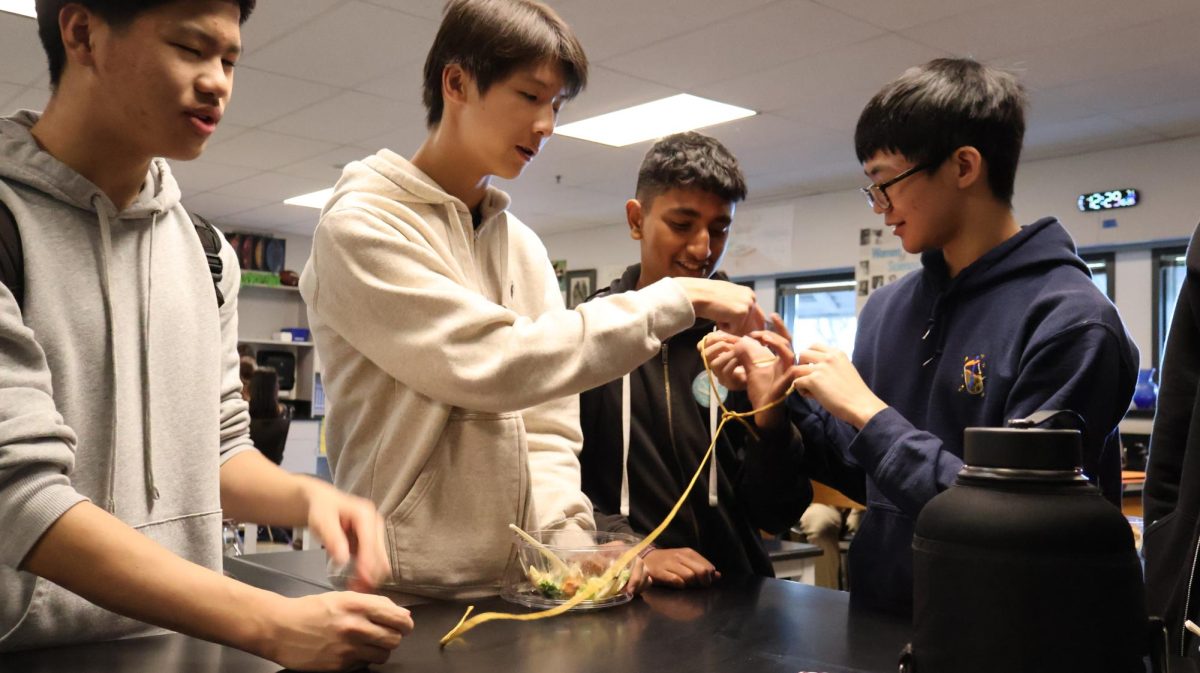
In Mr. Vargas’ room about every month, the Survival Club teaches students the skills they need if they wish to survive desperate situations in the wild. Founded by Kaden Yoo, Jonah Sharp, and Annika Mauldin, the club creates activities to engage people in learning these skills, from tying knots to carrying people. It is, according to Yoo, essentially a club to bring Boy Scouts to Wilcox. The club only started this school year, but they’ve “had a great amount of attendance” at every meeting, according to Mauldin, the club’s co-vice president. The Survival Club wishes to expand its reach to the rest of the school and create bigger and more engaging activities, even activities that may be outside of school.
Yoo explains how the motivation for the club is rooted in the spirit of Boy Scouts, which all three founders are a part of. “Boy Scouts teaches you vital life skills,” explains club president Kaden Yoo, “not just for surviving in the wild, but [it also teaches] leadership skills, organization skills, planning skills.” Because of what he had gained from Boy Scouts, Kaden “wanted to help students at our school learn the same skills we teach at our troop.”
To that end, Survival Club engages in many activities that teach students wilderness skills; for example, at one meeting they teach students how to carry people in case they are injured. The club went outside, Mauldin showed students the correct way to deal with a person who is injured and how two people must carry them. The club then conducted a race where two people must carry one person as fast as possible across the grass. Multiple groups of three or even four participated, and in the end Annika’s team won. Wilcox sophomore Anika Sainani, who often goes to club meetings, recounts a different meeting where they practiced knot-tying, and it was fun “because they made it a competition, which makes it engaging. If they just said, ‘go tie your knots,’ it wouldn’t be very fun.”
Yoo notes these survival skills are “critical elements of being in the wild that we …. emphasize a lot in Boy Scouts,” and that these skills are very useful even besides outdoor survival. While “it’s not every day you’re camping on a ten mile trek,” as Yoo remarks, it’s still useful when one is experiencing the outdoors, and it can even help in everyday life. “They’re developing skills that help them anywhere they go,” Yoo explains, “which I think is the true value of Survival Club.”
The club has held five meetings this school year, and 20-30 people generally attend each meeting—even though the club was only founded a few months ago—according to Yoo. Yoo claims that the club is “a diverse group—we have everyone from freshmen to seniors who come and support our club, which is great for diversity and promoting our club to the school.”
Mauldin says that the club may wish to hold out of school activities such as a camp in the park and hold activities related to the outdoors. “I wanna have bigger events, more things we’re doing, and teach people more,” she says. Thus, the club should, in her eyes, “advertise to more people in general.” Yoo expands on this, saying that the club wants to arrange a meeting teaching people how to make fire, “but this would obviously be done off campus.” He further notes that the club is planning an end-of-year party, in which they plan to celebrate with activities they’ve done in club meetings, such as competitions “to see who can tie the best knots chains [and] who can make the best tent.”
Survival Club’s activities involve skills that, while generally not taught in schools, are often life-saving. No one has to do these skills as part of the curriculum, save for CPR, and one can choose to learn these skills if they wish to survive in the most desperate of circumstances, in cases of emergency. Now, students are free to join this club so long as they wish to learn how to survive in the wild. Look forward to the next meeting in Mr. Vargas’ room whenever it comes up!