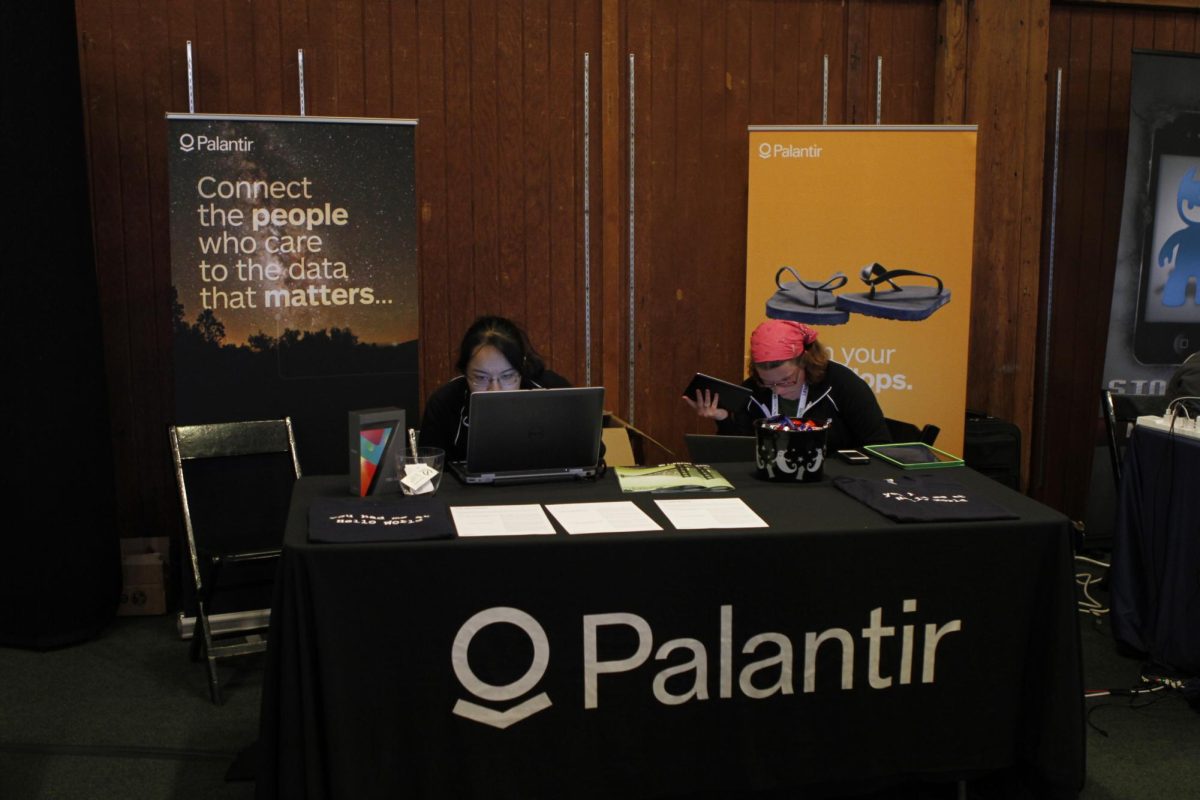
Palantir Technologies Inc. has been a name running through the headlines in the past year, billions of dollars in government contracts have been handed to this relatively unknown locally founded Palo Alto data analysis and integration company. From their deal with the U.S. Army with a decade-long $10 billion dollar enterprise agreement, to ICE with the creation of the “ELITE” app utilizing data from agencies such as the Department of Health and Human Services to provide a “confidence score” on suspects, Palantir has had no shortage of controversial business partners. However, in its 23 year long history it has had its fair share of collaboration within government with notably lending its Gotham AI in the unpopular War in Afghanistan during 2012 and aiding ICE back in the first Trump presidency. But most recently, Palantir has been in the limelight for something entirely different — its social media activity.
On April 18th, Palantir would post a 22-point manifesto outlining its beliefs and goals for the future of Silicon Valley on X. A summary of their 2025 book The Technological Republic: Hard Power, Soft Belief, and the Future of the West, Palantir’s co-founder, Alexander C. Karp, and head of corporate affairs, Nicholas W. Zamiska, lay out an argument for the superiority of Western culture and a revival of Silicon Valley’s role in America’s military dominance through the AI age via any means necessary. Although Palantir may stand out with their unconventional viewpoints, despite what they believe, they are merely a microcosm of the Valley.
The pioneers at Palantir recall Santa Clara county’s roots in Cold War military innovations. For them, gone is the golden age where Santa Clara was home to the production of all of the Navy’s ballistic missiles with companies such as Lockheed Martin and United Technologies (the latter now having merged with RTX Corporation, better known as Raytheon). The thing is those days never went away. The facilities for Lockheed, Northrop Grumman, and BAE Systems are still within the county and still provide defense technology for the country.
Furthermore, Palantir’s complaint that the companies in the Valley serve to “remain content to monetize our search histories even as they decline to defend our collective security” is untrue. The authors admit this themselves with their critique of Google’s decision in 2018 to drop support for the Pentagon’s AI automatic targeting system, Project Maven, after internal protests. Despite Google’s primary source of business coming from their services along with advertising, and their withdrawal from Project Maven, Google Cloud has been in active partnership with the Department of War (DOW).
Google’s Gemini AI was used to develop “GenAi.mil” —a platform aimed to streamline organization at the Pentagon. Besides having their direct partnership, Google has aided U.S. ally, Israel, in Project Nimbus which allows the Israeli Ministry of Defense to utilize its cloud infrastructure for AI powered air-strikes. Considering U.S. involvement within West Asia using Israeli assistance, most recently in the war on Iran as Israel has contributed substantially to air strikes in Iran, aiding Israel is a clear contribution to American militarism.
Technology conglomerate Meta Platforms, headquartered in Menlo Park, has also been aiding defense efforts. In 2025, Meta partnered with Anduril Industries, one of the collaborators on Project Maven, to develop combative “EagleEye” mixed-reality headsets for soldiers. Santa Clara’s NVIDIA and Mountain View’s Alphabet Inc. have also hopped on to the bandwagon, signing a deal with the Pentagon to provide AI tools for classified networks and military decisions.
All of this is to say, Palantir’s attitude towards technology is not specifically born out of Silicon Valley being disconnected from aiding the growth of the U.S. military-industrial complex. What Palantir specifically has an issue with is ethics. The central flaw within companies, such as Google, is the employees who they deem as lacking the courage to make ideological trade-offs while tackling the “messiness and moral complexity of geopolitics.” Even now with deals being made left and right between tech companies and the DOW, it’s evident that the moral compass of the human laborers behind these deals and those living in the Valley threaten its business model.
Incidents like the Project Maven protests are numerous. In 2024, after the lifting of restrictions on military application within OpenAI, they faced protests against the move from their workers as they aided defense company Andriul in improving the nation’s unmanned counter-drone system. Just in 2026, OpenAI was met with similar opposition as their employees alongside those at Google signed an open letter denouncing the companies in their negotiation with the DOW for opening their AI models to be used in “mass surveillance” and the “autonomous killing of people without human oversight.” Palantir themselves have also seen the brunt of the public’s resentment with their Palo Alto office being a target of frequent protests due to their support of U.S. ally Israel and ICE.
What then is to be done about the public’s conscience? How will the Valley return back to the age which Palantir describes as having “ravenous pragmatism and insensitivity to calculation” to launch projects such as Project Paperclip where we “recruit Nazis scientists, in order to retain an advantage”? Palantir says we must adopt “an inability to conform to those around us, to the cues and norms put forth by others… to decline to engage with external views at certain critical moments of an organization’s evolution.” This is exactly the route tech companies are moving towards. Even Google, who previously were swayed by protests against Project Maven, ultimately ignored over 900 employee signatures in favor of unapologetically allying with the DOW.
Moreover, it seems the company took to actively surveilling dissidence with one former employee, Laura Nolan, sharing with Fortune that “the company learnt from the Maven incident” and “started to crack down on internal communication, they decommissioned a lot of the internal mailing list… it’s harder to organize internally now.” Today we see the return to Palantir’s “Silicon Valley [which was] not immoral… they were simply amoral.” The lesson here is; compromising with the voices of opposition will halt the advancement of the U.S. empire and profits for the tech industry.
Control doesn’t just stop at the inner circles, there is still the hurdle of public sabotage for our tech friends in their mission in the “national project.” Ironically enough, Palantir references George Orwell’s dystopian hyper-surveilliance society of 1984 in calling out Apple’s rejection of its data for FBI usage stating that it was an act of abolishing the Valley’s “radical act of belief” within American culture. However, they see no issue with the act of surveillance itself. In 2012, Palantir lended their Gotham software to the New Orleans Police Department to organize and create connections in crime data. This wartime tech naturally led to backlash and fears over invasions of privacy.
Regardless of the success of surveillance in reducing crime, it has been proven that such systems are used to violate the rights of citizens. According to the Electronic Frontier Foundation’s investigation of widespread Flock license plate reader cameras, during 2024 and 2025 protests against ICE and Trump the cameras were used by police to surveil said protests with officers searching up terms such as “protests”—all without warrant. Additionally, in a case this year the Flock system was used by a deputy in Georgia to stalk a woman’s location for unlawful purposes. Similar cameras are also susceptible to being abused, as far back as 2021 they have been used for stalking in a case where a former officer in Pennsylvania pleaded guilty to stalking his estranged wife through license plate readers. Palantir’s explanation for this? These stories are but mere “preformative discourse” that causes us to “abandon a moral or ethical system oriented around results.”
Profit and violence work hand in hand, Palantir may claim that “no other country in the history of the world has advanced progressive values more than this one,” but upon closer examination that outcome can only be evident for our small minority. With the U.S. accumulation of power, it evidently comes with expectations of better living standards. As pointed out by Palantir, “the decadence of a culture or civilization, and indeed its ruling class, will be forgiven only if that culture is capable of delivering economic growth and security for the public.” Living in the Valley, we often forget we receive the fruits of capitalism from these tech business empires in our area. At the same time, that prosperity has created public consciousness in a way as an educated public comes to realize the inequalities they exist in. However, permanently abolishing those inequalities requires the recognition and rejection of our luxuries that have been created through exploitation.
Palantir quotes President Roosevelt on the topic of WW2 military development and research, “no reason why the lessons to be found in this experiment, cannot be profitably employed in times of peace.” That reality is no different today, the “times of peace” is simply for those living in the empire. It’s becoming increasingly clear that our times of peace are coming to an end as political instability clashes with an increasingly conscious public. Palantir is the embodiment of the sins of Silicon Valley, but the future promises that figures like them won’t be tolerated for long.