Among all the cases the Supreme Court faces this term, one of them may strike a critical blow to multiracial democracy. Louisiana v. Callais is a case concerning the constitutionality of drawing majority-minority districts in furtherance of the Voting Rights Act of 1965 (VRA). The justices are poised to strike down the practice, a ruling which would continue the onslaught the Court has unleashed on the VRA and take our nation further away from the ideal of an inclusive democracy.
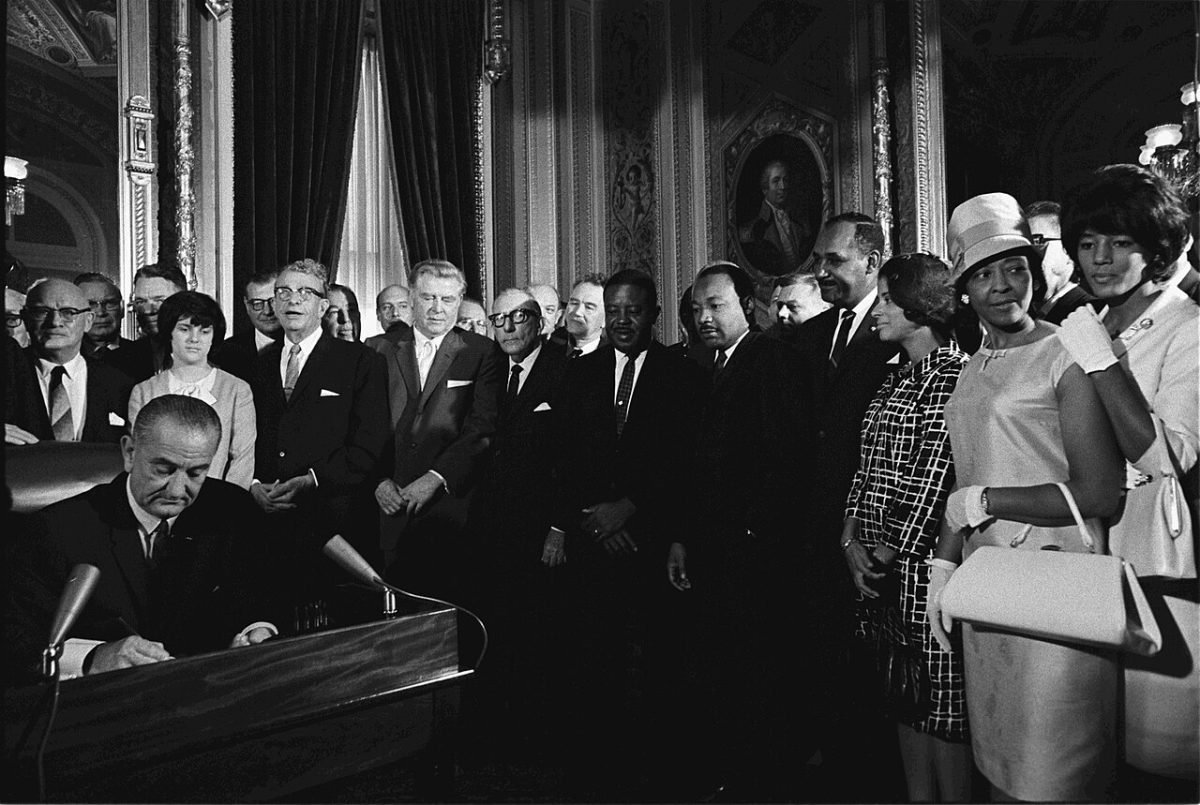
Before the VRA, African-Americans had virtually no voting power. Even though the Fifteenth Amendment guaranteed the right to vote regardless of race, Southern states circumvented this via poll taxes, literacy tests, and yes, gerrymandering too. With the civil rights movement, voting rights for minorities became an important issue, hence why the VRA was signed into law. Section 2 of the Act provides that members of no race shall “have less opportunity than other members of the electorate to participate in the political process and elect representatives of their choice.” This has been interpreted to prohibit states from unfairly diluting the power of racial minorities in drawing electoral districts, thus enabling states to draw majority-minority districts where an ethnic minority makes up most of a district’s population to ensure members of that group have equal representation in government.
After the 2020 census, Louisiana redrew its congressional map for its six congressional districts, creating one majority-minority district with a mainly African-American population. However, a third of Louisiana’s population is African-American, so black plaintiffs sued the state on the grounds that an additional majority-minority district was necessary. In 2024, Louisiana’s legislature drew a new map after a court struck down the previous one, leading to a lawsuit from a group of self-described “non-African American voters,” who argued the new map was a racial gerrymander in violation of the Fourteenth Amendment’s Equal Protection Clause. Callais eventually went to the Supreme Court, where it was argued in March 2025. However, the Court scheduled Callais for reargument in its 2025-26 term, directing the parties to argue whether the new map was unconstitutional.
While it may seem that intentionally drawing boundaries to benefit minorities is just as bad as gerrymandering to lessen their power, this is simply not the case. Race has plagued our nation since its founding, as even though slavery ended in 1865, the racism and prejudices against African Americans that developed during that period continued for another century with discriminatory laws in the South. Even after that, they have faced much discrimination and lessened opportunities. The purpose of these race-based districts is to level the playing field, not unfairly advantage minorities. This idea is supported even on the originalist grounds legal conservatives so often support: an amici curiae brief filed by history and law professors in Court’s 2024 affirmative action case notes the framers of the Fourteenth Amendment supported special programs for African-Americans, not seeing it as discrimination but as a way to help their position in light of the fact that they were long disadvantaged in comparison to white people. While affirmative action is a separate issue from majority-minority districts, both are race-conscious methods to make society more equal to achieve, not hinder, the Fourteenth Amendment’s promise.
Conservatives then shift to argue race-based districts were fine in the immediate aftermath of Jim Crow, but now no more. During reargument in October, Justice Brett Kavanaugh told a lawyer defending Louisiana’s new electoral map that “race-based remedies are permissible for a period of time … but they should not be indefinite and should have an endpoint.” This logic mirrors that of the 2013 decision Shelby County v. Holder, in which the Supreme Court struck down the VRA’s preclearance formula that required federal approval for states with a history of discrimination to pass voting laws. Chief Justice John Roberts argued in the majority opinion that because African-Americans’ voting power had increased tremendously, requiring certain states to get their voting laws cleared was unnecessary. After the ruling, those same states have enacted restrictive voter ID laws, closed hundreds of polling centers, and enacted other restrictive measures, according to the NAACP Legal Defense Fund. Clearly, the VRA itself was keeping multiracial democracy in check, and weakening it again will further undermine our democracy.
Although Callais is not being argued over whether the Act itself is constitutional—only whether a practice under it is—striking down Louisiana’s second majority-minority district will have enormous consequences. It would open the door for legislatures to crack districts to separate voters by race, creating inequalities in voting power. While many may focus on Callais’ direct political effects, noting that it could lead to Republicans and Democrats increasing their seats in states they control, it presents a danger for the future because if the time comes when state governments believe in racial superiority once again, the slide down to oppressing minority voters will already have been partly set, thanks to the Supreme Court. We can only hope the Supreme Court does not strike down the map, and if they do, it should remind us that the fight for equality is never over.