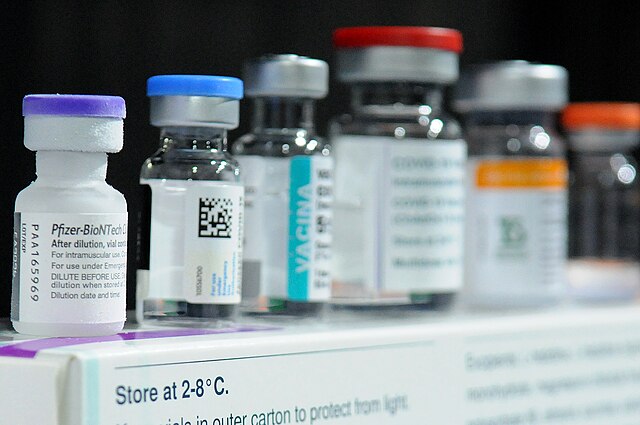
Secretary of Health and Human Services (HHS) Robert F. Kennedy Jr. has introduced new limits to vaccine access and cut federal vaccine research funding. Scientists warn these moves could undermine years of progress against infectious disease.
In his seven months in office, Kennedy has pushed forward new federal policies that include: scaling back access to COVID shots; slashing funding for mRNA research; and moving to delay routine Hepatitis B vaccines for newborns. Kennedy argues that these steps address safety concerns and government overreach in public health, but many experts believe that they are not based in scientific fact. “These policies and others being debated could abruptly and dramatically reduce vaccination” says Dr. Nathan Lo, assistant professor of infectious disease at Stanford University. “This could lead to a resurgence of many infectious diseases, and preventable hospitalizations and deaths.”
Since 2021, the U.S. Centers for Disease Control (CDC) has recommended COVID shots to everyone six months and older. On May 27, under Kennedy’s direction, the HHS withdrew this guidance for healthy children and pregnant women. Then, just three months later, the U.S. Food and Drug Administration (FDA) limited approval for new boosters to people over 65 or with chronic health conditions, a sharp break from previous years. On September 19, the CDC’s advisory panel offered a partial reprieve—now, anyone over six months can receive the vaccine, but only after consulting a doctor or pharmacist.
Among Kennedy’s many arguments, he claims that COVID vaccines are dangerous for pregnant women. But a paper published in JAMA Pediatrics shows clear benefit, estimating that vaccinating all pregnant mothers could prevent about 2500 hospitalizations in newborns over a 17-month period. “COVID-19 vaccination during pregnancy has been rigorously shown to be safe for both mother and baby,” says Dr. Lo, the paper’s first author.
On August 5, the HHS announced that it will be canceling or scaling back at least 22 mRNA research projects worth about $500 million dollars. Kennedy has claimed that mRNA vaccines have “failed to protect effectively against upper respiratory infections” like COVID and flu, and are less safe than other vaccines. But experts argue that mRNA technology has averted millions of COVID deaths and hospitalization, and that cuts will leave the country vulnerable to future pandemics. “Cutting mRNA research funding isn’t just about COVID,” says Dr. Kristin Sainani, a professor of epidemiology at Stanford University. “The technology has many other applications, even treating cancer.”
On September 19, the CDC’s advisory panel discussed–but ultimately tabled–a proposal to delay the first dose of hepatitis B vaccine for newborns whose mothers test negative for the virus. The longstanding policy, in place since 1991, requires that all infants receive a hepatitis B shot within 24 hours of birth. Under the draft proposal, babies born to hepatitis B negative mothers would receive their first dose at one month instead.
Kennedy has argued that the vaccine is only necessary for the infants of mothers who test positive for the virus. However, Dr. Sainani warns that maternal testing can miss infections and waiting a month to administer the shot risks parents never returning for their child’s vaccine. According to the Hepatitis B foundation, the U.S. birth-dose policy has resulted in a 99% decline in Hepatitis B in Americans under 19 since 1991. “It’s crazy that officials are considering reversing a highly effective public health policy that has saved tens of thousands of lives with virtually no downside,” Sainani says.
Kennedy’s restrictions have not hit California as hard as some other states. After the FDA limited COVID booster coverage, patients were only eligible if they were over 65 or had a chronic condition. However, in California, what counted as a “chronic condition” was interpreted loosely and “you could get the shot if you really truly wanted to,” says Sunnyvale Walgreens Pharmacist Technician Mary Ann Smith. “If your mood ring was black, you have a mood disorder. If you sit at a desk all day, you eat food in America, you’re probably unhealthy and therefore at risk.”
On September 17, California passed AB-144, which makes anybody six months and over eligible for the COVID vaccine, and mandates that state-regulated insurers must pay for it. Along with Oregon, Washington, and Hawaii, California has also formed the West Coast Health Alliance to provide science-based vaccine recommendations to counter federal policies. Californians may find these rapidly changing policies are “very confusing,” Mary Ann says. “But we are here to walk people through it.”