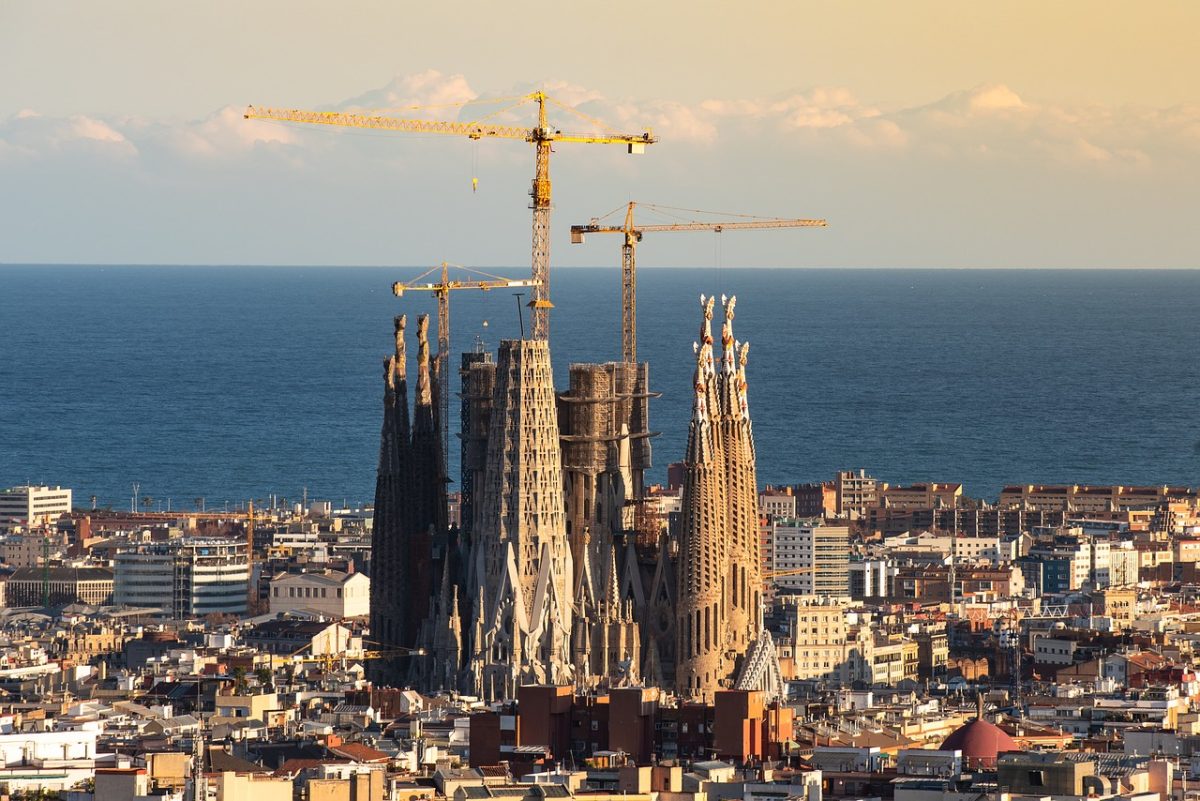
Cranes permeate across the Barcelona sky as rocks are chipped away at, filling the air with the sounds of clinking and drilling. Scaffolding spans across hundreds of feet before unveiling the Sagrada Família, the world’s most famous unfinished building. This scene, unchanged for decades, stands tall as a symbol of human endeavor, hoping to keep the promise of Antoni Gaudí and his vision. The trek that it took to get to this point has been long, and Gaudí has not been alone, with several notable figures involved throughout his journey. The Sagrada Família is not only designed to be a place of worship, but a commemorative work of art built to tell the stories of the many people who worked on it.
Originally conceived in 1882, architect Antoni Gaudí aimed to begin a project that envisioned the tallest church in the world, the goal being to hold such monumental height as a representation of reaching God. Driven by faith, Gaudí would tell stories through intricate designs and sculptures. He designed high tree-like structures and the layout of the facades titled Passion and Glory located on the western and southern side of the structure,respectively. Gaudí’s artistic genius would continue to influence the construction before his death in 1929. Despite this unfortunate event, his creativity and pursuit of faith still continued to inspire those remaining to work on his project. Although, as a result of the Spanish Civil War, his workshop holding the original designs of the church had been destroyed. As a result, all that was left behind was scraps that subsequent architects would interpret his vision with, managing to substitute as a primary blueprint for the ongoing construction.
This monument had not only been driven by Gaudí though, as men such as Josep Maria Bocabella, a Spanish bookseller and philanthropist, would utilize his religious publishing house to promote influential magazines regarding the construction. His actions would secure his burial located in the crypt of the Sagrada Família, cementing him as a devout member of the church. A member similar to Domènec Sugrañes, who would take the role as the head architect after Gaudí’s death, overseeing the construction and managing to decipher the original architect’s works after the destruction of his workshop in 1936. Today, the Sagrada Família’s completion is owed to Japanese sculptor, Etsuro Sotoo, who is also referred to as “Japanese Gaudí” due to his dedication to completing the original vision of the landmark. He is recognized for blending profound artistic detail with functional architecture, aligning with Gaudí’s philosophy and ideas. So far, he has dedicated over four decades to carving and completing Gaudí’s masterpiece, creating around 500 sculptures for the basilica including Musician Angels, and the Nativity facade on the east.
Through the years of hard work and architectural pursuit, the crowning moment took place in early February of 2026 when engineers made the final cross atop the central tower of the basilica. This raised the structure to its full height of 566 feet, officially marking the Sagrada Família as the tallest church in the world, surpassing Germany’s Ulm Minster. The basilica has now achieved the outline Gaudí envisioned over a century ago, spires that redefine Barcelona’s horizon as scaffolding is removed from the completed sections. Despite this achievement, work still continues with plans to implement stained glass that transforms sunlight into mottled forest light, as well as pews and altars needed for the remaining chapels.
Looking ahead, the Sagrada Família’s future promises to become an architectural achievement of collective faith in beauty. Plans have already been underway to complete the finishing touches of the basilica, with the majority of the work shifting over to the Glory facade, intending to be the most monumental of the three facades. Interior and exterior decorations, including more sculptures and stained glass, will continue to be worked on into the 2030s. In order to accelerate the final phase of the project, modern technology has been introduced, including 3D printing and computer controlled stone cutting. These technologies aim to complete highly complex designs while blending in traditional masonry with advanced engineering. This allows for faster construction while staying as true as it can be to the original vision. As this final era of modern technology pioneers the completion of the Sagrada Família, the dream of Antoni Gaudí will be able to be fulfilled.