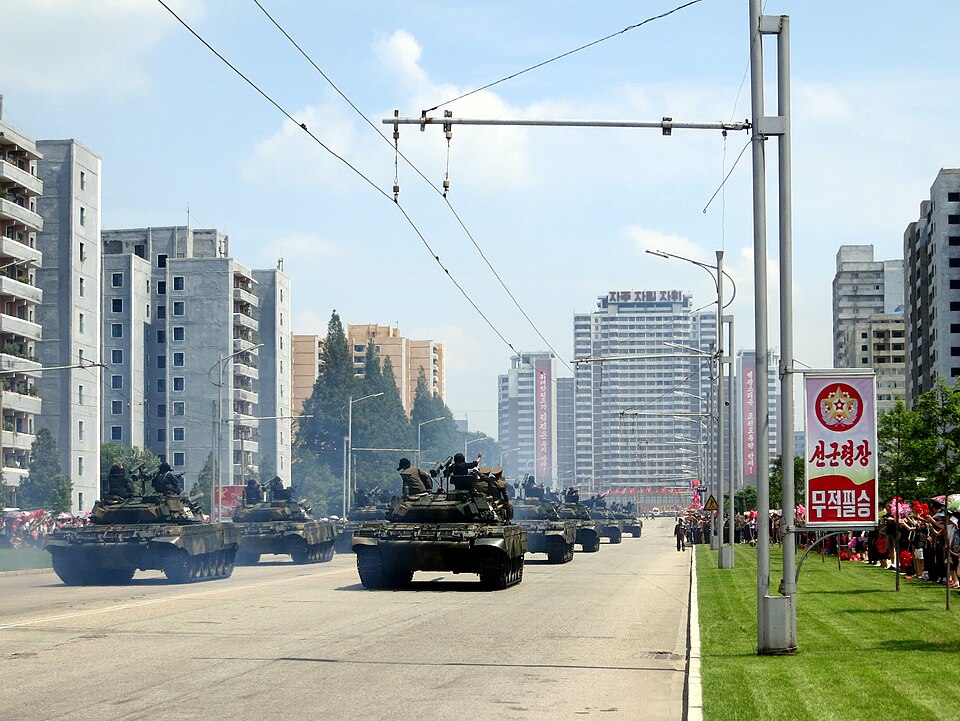
“Reluctantly but significantly, North Korea’s most powerful ally has abandoned the pursuit of a nuclear-free Korean Peninsula,” explained Tong Zhao, a senior fellow at the Carnegie Endowment for International Peace, whose research centers around nuclear arms relations between the US and China. On September 3, Kim Jong Un, North Korea’s Supreme Leader, attended the Chinese military parade in Beijing. A celebration recalling Japan’s surrender during World War II, Kim stood side by side with Xi Jinping and Vladimir Putin, China and Russia’s respective leaders. And for the first time in several years, there was no discussion of North Korean denuclearization in transcripts of the summit—a sharp contrast to the five prior meetings. So where does that leave things, within the Asian peninsula and the world beyond?
Looking back to the 14th century, the power dynamic between the two nations began on a slant, based around a Sinocentric system—essentially, crowning China and its emperor as the political and economic heart of the world. China viewed itself as the center of civilization, colloquially known as the “Middle Kingdom,” surrounded by less advanced countries and cultures. Korea was considered a prized tributary state under the Ming dynasty, exchanging gifts of resources to obtain an economic relationship with the powerful empire. This relationship lasted for over a millennium, and China’s Neo-Confucianist principles—a revival of traditional Confucian concepts blended with newer Buddhist beliefs– became foundational throughout the Korean Joseon dynasty, which ruled from 1392 until 1910.
Centuries later, during the Cold War, relations became more strained when premier Kim-Il Sung– referred to as the “sun of North Korea”– suggested the UN begin to remove foreign troops from the peninsula to kickstart the process of unification. This resulted in Chinese Communist Party (CCP) Chairman Mao Zedong calling Kim Il Sung “traitorous,” as the removal of foreign troops disrupted prior agreements with China and the USSR. Nevertheless, China still provided the struggling North Korea with 230,000 tons of food, despite China’s own famine during their period of rapid industrialization, the Great Leap Forward.
In the 1950s, tensions between the USSR and China fractured—Zedong opposed Soviet Prime Minister Nikita Khrushchev’s path of de-Stalinization, as laid out in his 1956 Secret Speech; Zedong viewed cooperation with the West and modernizing the economy as an affront to anti-revisionist Chinese communism. Similarly, Kim Il-Sung separated himself from the Soviet Union, and aligned North Korea with militant Chinese political values. This amiability at the beginning of the 1960s is reflected by the Sino-North Korean Mutual Aid and Cooperation Friendship Treaty signed in 1961. However, this relationship fragmented as the decade continued—China’s refusal to advise North Korea’s nuclear program and border skirmishes between the Chinese Red Guard and Workers’ Party of Korea contributing to this. Interactions continued to complicate as the decades passed; North Korea viewed China’s connections with the United States and South Korea as a betrayal.
This sense of power imbalance and distance has lingered over time. The centralized Democratic People’s Republic of North Korea is both economically and diplomatically reliant on China, given 80% of its trade comes from China since 2010.
In terms of China’s present attitude toward North Korea, according to the US-China Economic and Security Review Commission, China’s policy can be summarized with three simple dictates, “no war, no instability, and no nuclear weapons,” clearly emphasized through the 21st century by the Six-Party Talks and Chinese support of UN sanctions on nuclear materials.
But the latter part of this stance seems to have taken a drastic turn. At the aforementioned nuclear parade in Beijing, only two out of the twenty six world leaders present were invited to a private tea time at Xi’s home in Zhongnanhai: Vladimir Putin and Kim Jong Un. With China no longer pursuing denuclearization so aggressively, Kim was greatly encouraged to complete the final test of a high-thrust, solid-fuel rocket engine. This model, intended to power an intercontinental ballistic missile (ICBM) Hwasong-20, is easier to conceal and transport than those using liquid-fuel. It is possible that China has taken AUKUS, an Australian nuclear submarine project supported by both the US and the UK, as a sign that global nonproliferation is no longer a priority for both Washington and other members of the UN Security Council.
China’s stance cannot be predicted with total certainty—the recent summit and fears of an East Asian nuclear domino effect still warring out—but Kim Jong Un has made North Korea’s attitude very clear, announcing, “The world already knows well what the United States does after it forces a country to give up its weapons…We will never put down our nuclear weapons.”